In the run up to each exhibition we run Live and Learn workshops, one before we open and one in the opening week. These workshops are a social and creative opportunity for Fabrica volunteers and staff to come together to discuss and explore the themes of the exhibition, run by artist and facilitator Jane Fordham. Before we dive into the activity we have food and drinks together!
Our most recent workshops were an exploration of our current exhibition: At Home in the Water by Vanessa Daws. The sessions involved a mixture of creative writing in response to the sea, and the opportunity to get creative with seaweed, inks and printmaking techniques!
Our research was as background information for an upcoming Exhibition at Fabrica by the artist Vanessa Daws’; At Home in the Water’, part of a larger project ‘, Swimming a Long Way Together.’
The plan was that we would research the history of sea swimming around Brighton, with particular reference to a woman called Mercedes Gleitze, who was the first British woman to swim the English Channel, which she completed in 1927 on her seventh attempt.
I had no reference personally to swimming of any kind , sea or otherwise, and have always felt nervous in open water if I couldn’t feel something solid under my feet( ie being out of my depth). We were given a book to read ‘ In The Wake of Mercedes Gleitze’ , which was written by her daughter Doloranda Pember. This was my first contact with the life of this Brighton born woman whose last public swim was in August 1937.
Using the contents of the book as a reference point ,opened up the world of of outstanding endeavour and achievement that had encapsulated the life of Mercedes Gleitze.
We discovered that she was born in Brighton in 1900, her birthplace now adorned with a Blue Plaque, the site of which we subsequently visited, and that her upbringing was divided between her parents homeland of Germany and Brighton itself, the First World War years of separation from her father , who we discovered had been interned on the Isle of Man, and her own subsequent determination to live her life in England post 1918, which she did.
Trip to the British Library
By researching further and using resources such as on- line , and at Brighton Library and The British Library in London, we were able to put together a comprehensive picture of Mercedes and her era, when endurance swimming by any female was regarded by society at the time as being anomalous, and women who indulged or attempted pursuits such as swimming the Channel or flying a plane were looked upon as being somewhat strange creatures, and really they would have been better served being at home bringing up a family ‘ in their proper place’.
All this background information was completely unknown to me initially, and it was rewarding to have been able to accumulate this knowledge through regular catch up meetings with fellow archivists on the project and by becoming members of The British Library. Altogether a rewarding experience.
This summer my wife and I were travelling in Austria and on the train I picked up a free magazine and noticed a picture of Mercedes Gleitze on the first page, in an advert for Rolex Watches. For the remainder of the train journey, I then proceeded to inform my wife who the swimmer was in the photo, telling her all about Mercedes and her achievements and connection to Brighton.
Studying Art History, Fine art and Modern History at BHASVIC, has changed my perception of art in its entirety, extending it past the old hobby it was, into something which I believe, has the power to significantly impact someone’s life for the better. This is a notion that has only been reinforced during my time volunteering at Fabrica.
After hearing about the opportunity from my art teacher, Alex, I initially applied in hopes of both getting to know the contemporary art scene in Brighton a bit better and to gain some useful work experience to add to my university application. Whilst it has undoubtedly aided in both of those goals, I think it’s really the community that Fabrica has fostered, which has been the thing I’ve taken away most from the experience. The amazing scope of events is something I was completely unaware of prior to coming to volunteer here, but is a fundamental aspect of the gallery which anyone, artistically inclined or not, has the opportunity to get stuck into.
The inclusive, friendly and creative nature of both the volunteers and the people visiting makes Fabrica an incredibly inviting place to find yourself in and I’ve especially enjoyed interacting with the abundance families who attended our last exhibition – the comments the children wrote in our review book were particularly entertaining (and I’d recommend having a flic through it next time you pass by).
I am currently in my second year of college studying English, Art and Art History for A Level After college I hope to attend University and study History of Art with the hopeful end goal of finding a career somewhere within the field of restoration or curation. I really enjoy making my own art and consider it alongside reading as one of my favourite hobbies, working at Fabrica was great for both of these as it gave me heaps of inspiration for my art as well as new areas of art history to read up on.
I first heard about the possibility of volunteering at Fabrica through my art teacher at college. He recommended it as an opportunity to find some work experience in a relevant field as well as a way to get involved in the local art scene. When I joined the volunteer team at Fabrica I was looking to gain a little more experience in the workplace and some insight into a field which I hope to join.
Though more importantly I hoped to share my interest in art with others and engage in conversation in an environment of equally passionate people.
About Fabrica I would describe Fabrica as creative, collaborative and community-driven
I actually attended primary school just around the way from Fabrica so in my mind I will always think of it as a place for curiosity and discovery because that’s what it was to me when I was younger, this kind of magical place which me and my brother could explore and play in.
One of my favourite parts of volunteering at Fabrica was having an opportunity to contribute to our exhibitions run of the Response magazine. It was so amazing working with other volunteers and staff to create a piece of work that visitors were able to use to further their understanding of and engagement with the exhibition. It gave me a much greater understanding of the steps taken to get a project from the initial conceptual stages to a finished product and the conversations and ideas we got to explore as a team are something I’m so glad I got to have been a part of. I think the most enjoyable aspect of volunteering for me was greeting people at the front desk. Though at times it can be a little stressful trying to make sure you’ve briefed each visitor, it was an overall rewarding experience to make sure everyone knew they were welcome at Fabrica and it let me see firsthand people engage with art work in countless different ways. I also found it to be another great opportunity to discuss with people a topic I’m passionate about. I like to think that I maybe contributed just a little to people’s enjoyment of the exhibition.
I think aside from all the technical and workplace skills that Fabrica has helped me with, my most significant take away from this experience has been the real life connections I was able to build during my time volunteering. Through Fabrica I’ve been able to meet so many interesting and like minded people who have really inspired me to get involved with my local artistic scene.
I am really proud that I’ve had the chance to be a part of Fabrica!
Ahead of our current exhibition, At Home in the Water by Vanessa Daws, the volunteer team had the pleasure of visiting a few exhibitions in London which explored discreetly similar themes.
After a cosy morning train ride, the group made their way to The Wellcome Collection for In The Air. Showcasing a variety of artists, scientists and makers, the exhibit questioned whether or not we all truly ‘breathe the same air’.
The exhibition drew attention to the ways in which our collective relationship with the air has inherently changed since the pandemic. In thinking about not only the socioeconomic, but environmental factors which affect our air, we were drawn to think about the inextricable relationship between the air and the sea; an important element of At Home in the Water.
Did you know that between 50-80% of the world’s oxygen comes from the sea?
We also looked around Wellcome Trust’s permanent collection, which features a host of items all relating to the history of public health. We were then confronted with questions to do with the human body. Mercedes Gleitze, the early 20th Century swimmer who also features in At Home in the Water, swam for reasons to do with endurance, but also for its wonderfully euphoric effect on the body. Cold water swimming is famous for its health benefits, and became something of a ‘craze’ in pandemic and post-pandemic Britain.
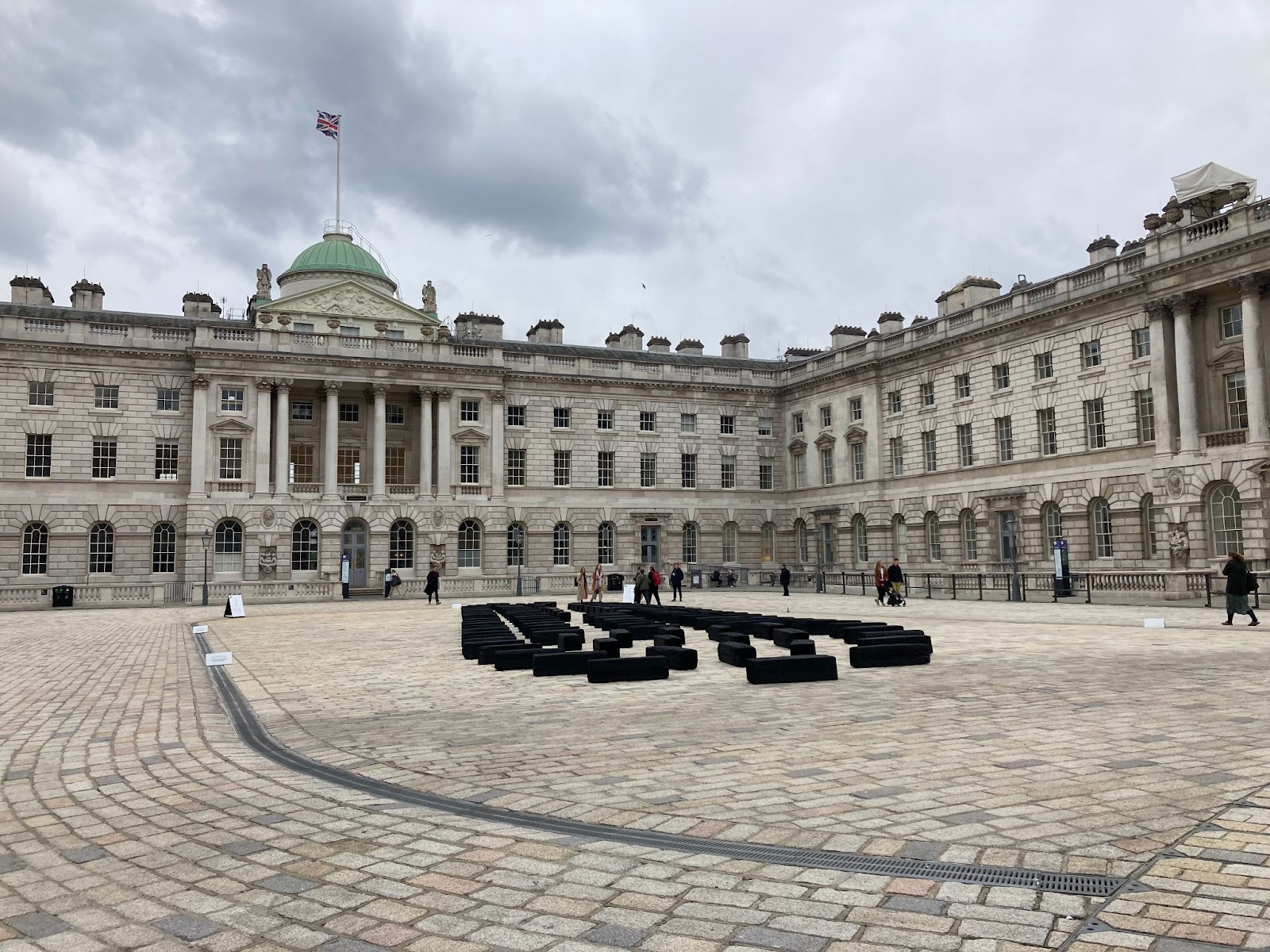
After lunch, we went to Somerset House to visit a few open studios, and see Grada Kilomba’s, O Barco / The Boat.
Grada Kilomba’s, O Barco / The Boat
Situated in the Somerset Courtyard is a striking 140 of charred wooden blocks composing the ‘lower ‘hold’ of an historical European slave ship’. The blocks are hand-inscribed with a poem written in six different languages.
While the sea is often viewed as a symbol of freedom, O Barco / The Boat encouraged us to consider the fraught history of maritime colonisation. The installation is currently on tour; we encourage those who are able to seek it out.
‘What stories are told? Where are they told? How are they told? And by who are they told?’
We then visited a few unique galleries within the house. First, GALLERY 31: SWIMMERS LIMB, curated by Taylor Lemelle, featured a series of abstract art which, we realised, was not exactly related to swimming. In fact, the theme of the exhibit was that it had no theme. But we enjoyed it nonetheless!
We ended our excursion with the atmospheric We Can No Longer Deny Ourselves by SERAFINE1369. The installation was situated around the theme of how we experience time.
Featuring footage of artist Vanessa Daws’s hours-long endurance swim, At Home in the Water also begs us to consider how we measure time in moments which call for heightened endurance and perseverance.
After seeing so much in a day, we returned to Brighton anticipating Fabrica’s new exhibition even more than before. We were thrilled to have broadened our minds to the ways in which we can think about sea swimming, endurance and the arts, and relate them to our own individual experiences.
On the 24th of August there is a special crazy golf competition for volunteers, staff and Fabrica supporters. All are welcome to bring family and friends to the event as well so you can create teams of 4 people. If you prefer, there is also the option to sign up as a solo player and be put in teams of 4 on the night with other solo players.
Aside from putting your crazy golf skills to the test, there’ll be also time to mingle and socialise throughout the evening with a bar and some music. Golf fancy dress is highly encouraged!
All ticket sales and bar profits will go towards supporting Fabrica and it’s people.
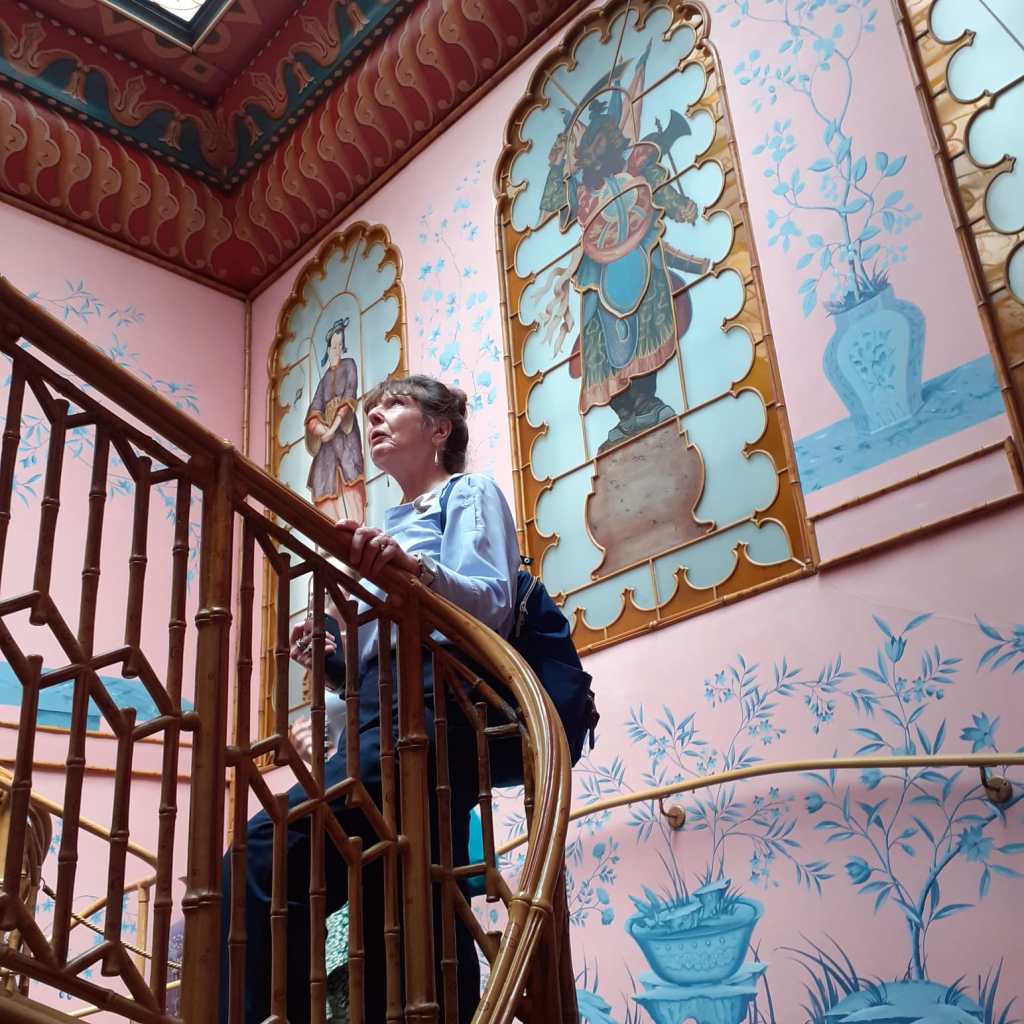
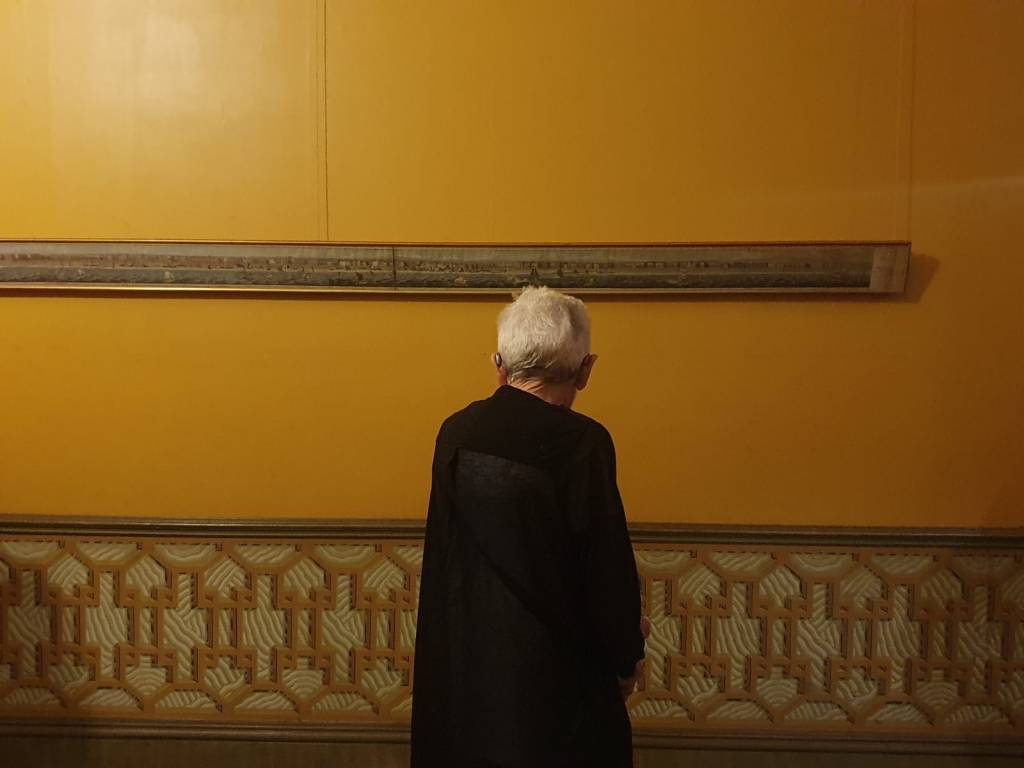
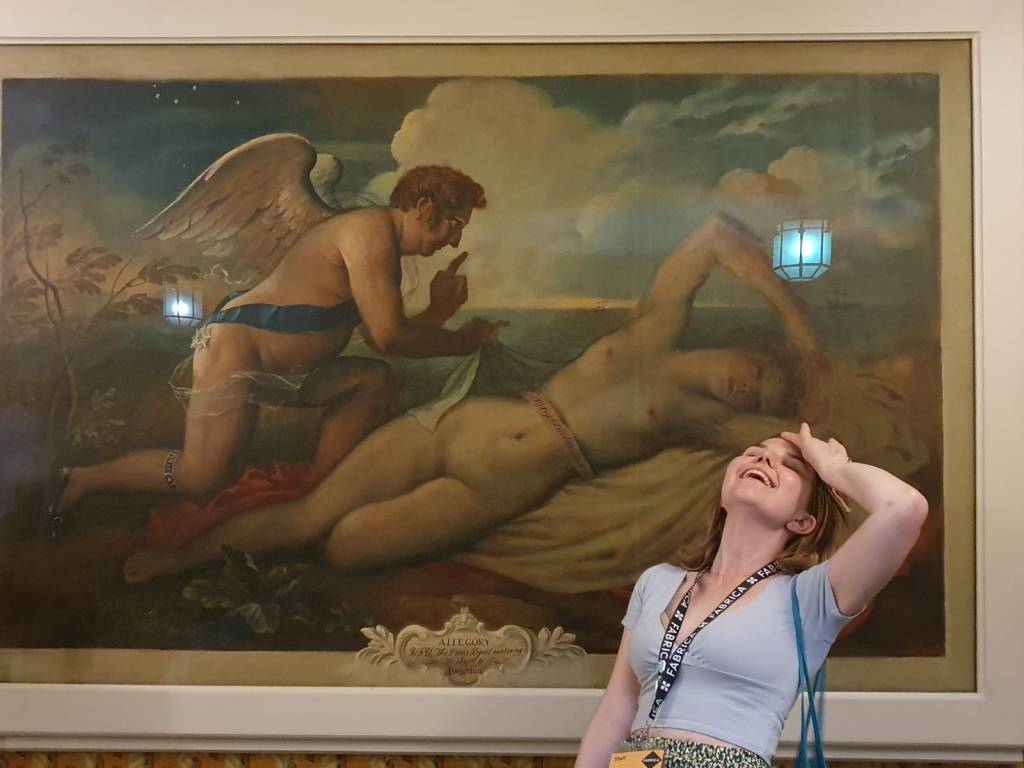
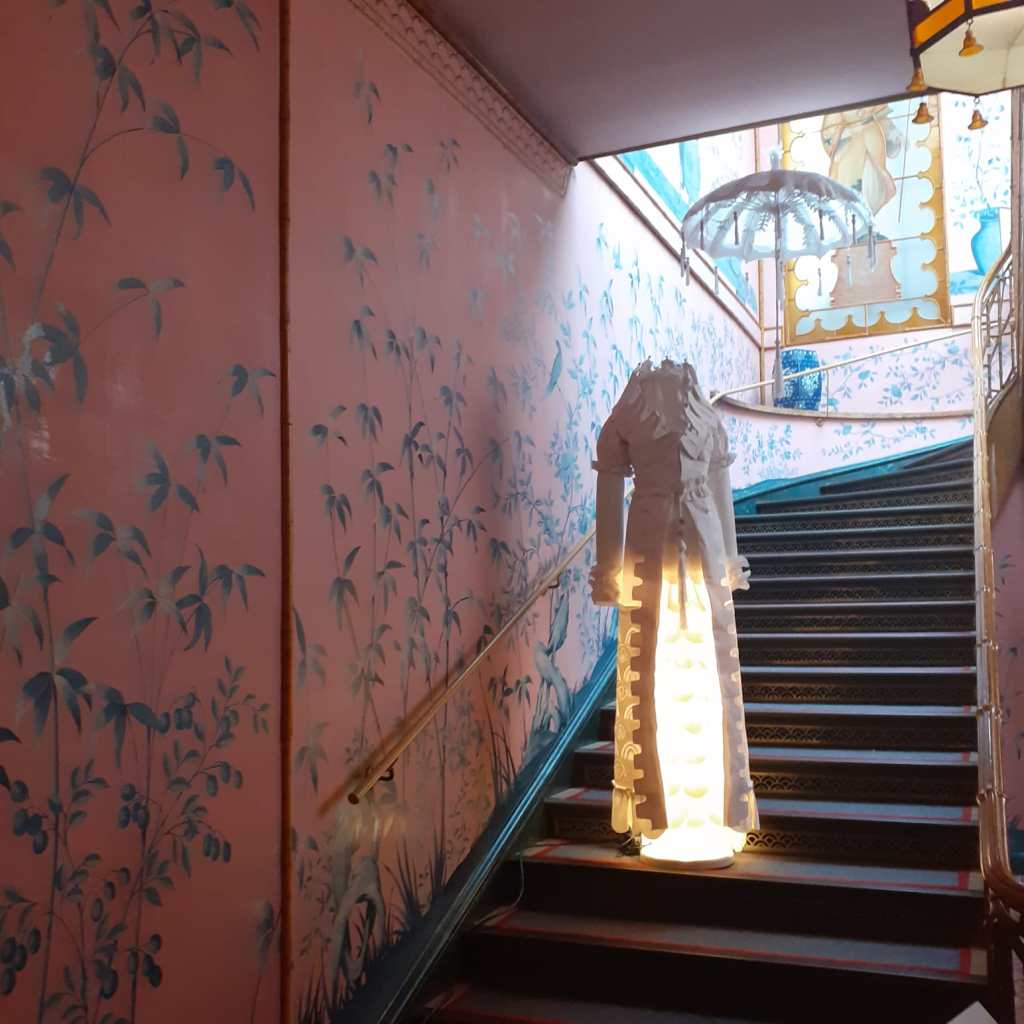
On the 16th of June, we took some of our lovely volunteers to a sunny and hot day trip to the Royal Pavilion. It was the perfect day to learn about the history of the building and admire the overall colourful architecture. Here are some of the highlights of the day.
After taking a break to enjoy the weather by the Pavilion Gardens Café, we also had the honour to have a talk from the curator of the Pavilion Alexandra Loske about her job in curation. Loske talked about her professional history, how historical items get loaned to other galleries, the recreation of interiors, how auction houses operate, and how temporary exhibitions happen in the space like the Regency Wardrobe collection with the costumes being made out of paper.
Summer is always an exciting season at Fabrica. In addition to our current exhibition, My Crazy Family Golf, we also have several forthcoming activities for volunteers, including three opportunities to submit original work – or rather, responses – to our volunteer-led publication, Response Magazine.
Keep reading for a bit more information on our submission specs.
1. Our Crazy Fabrica Jenga Tower
Deadline: Friday 12 August
Towards the end of August, the Response team will build a Jenga Tower with blocks altered by yourselves to display in the gallery alongside My Crazy Family Golf. There are no strictures as to what you may do to your Jenga Block; paint it, burn it, dye it – it’s up to you!
You would have received a Jenga block if you were in attendance at our volunteer briefing a few weeks ago. If you were not, feel free to swing by Fabrica to pick one up, as there are plenty left to play with.
2. The Magazine
Deadline: 31 July 2022
For this summer’s issue of Response Magazine, we’re asking volunteers to contribute submissions in alignment with our summer exhibition, including but not limited to work that grapples with:
– Family relationships/domesticity
– Games, participation or collaboration
– Care and caring
Submissions may take the form of any media, from photograph to sculpture to poem. Perhaps you will decide to collaborate with a family member, like Lisa and Gordon. Or perhaps you might decide to write a poem in the style of rules to a game. Submissions are not limited to new work, so if you have created something in the past that fits our theme, please do send it along.
3. Your Own Crazy GolfCourse
Deadline: Friday 12 August
As directly inspired by My Crazy Family Golf, Response Magazine will be accepting mini golf course sketch-ups of your own design. If you were at our volunteer briefing a few weeks ago, you would have received a paper template to use as a starting point for your own crazy golf plan. However, please feel free to start from scratch if you wish, or make use of the digital templates attached at the end of this article. This is a highly interpretive project, so do let your imagination run wild.
We have already received loads of excellent submissions and look forward to receiving more in coming days!
As always, thank you for all your hard work and dedication to Fabrica. Happy making!
Our Fabrica volunteer celebrations consisted of three events on the same day, by Fabrica volunteers and for Fabrica volunteers
Yoga Session at Fabrica – run by volunteer Savita Burke
A special relaxing yoga session, accessible for all abilities and levels.
All the volunteers who took part felt refreshed, relaxed and well stretched and Katherine commented “With gently powerful, deep, slow stretching and breathing exercises, Savita’s yoga class has a meditative quality about it. I felt calm and grounded for the rest of the day.”
Volunteer Tea Party
We had a delicious tea party with cake, fruits, sausage rolls. One of our volunteers brought in homemade cornflake clusters which went down a treat. We also played some games which included “Obama Llama”!
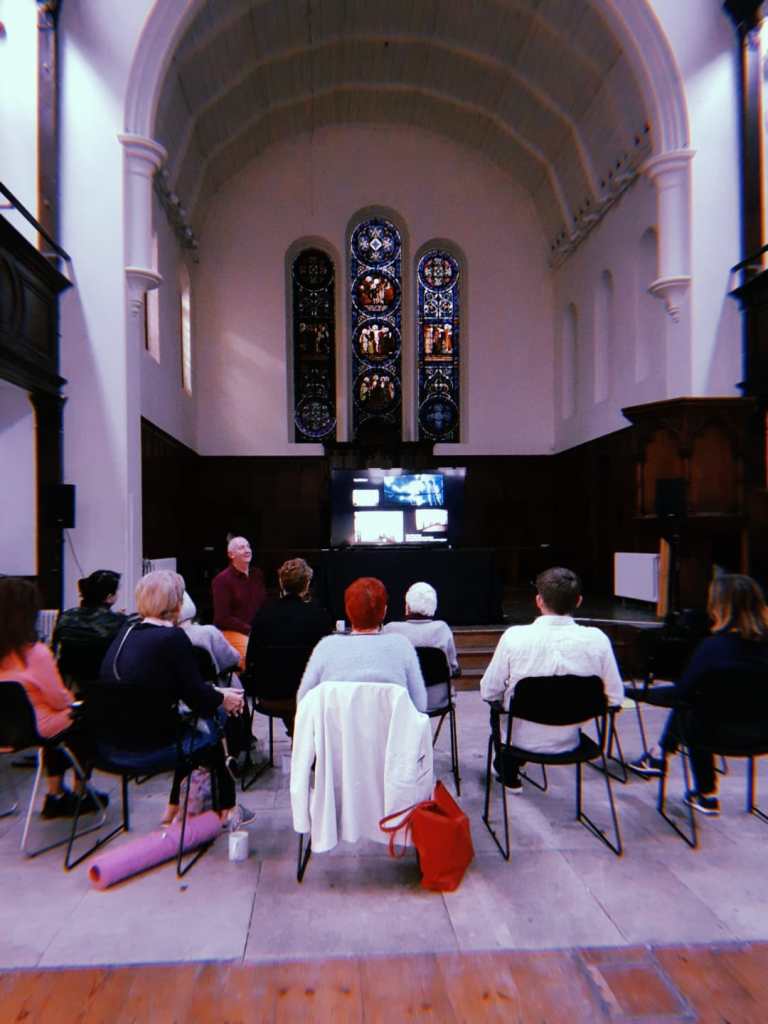
Artist Talk – Christopher McHugh organised by Jo a volunteer
A talk with slides from artist Christopher McHugh. Christopher also has a great connection to Fabrica, in that he was one of the founding members.
Christopher McHugh has considered himself a painter although, over the years, he has also made work in a range of other media and contexts. He trained in painting at Stafford College of Art, Bath Academy of Art and Manchester Polytechnic (now Manchester School of Art within Manchester Metropolitan University) and studied later at The University of Sussex. He has taught Fine Art at degree and postgraduate level for more than 20 years. Themes in his painting have varied but have always been interested in the relationship between medium, materiality and ‘reading’.
Colour seems to figure largely as a sort of language unto itself and as a metaphor or model for a complex range of sensations and ideas. A series of what he refers to as ‘pictorial memes’ have shaped the appearance of his paintings into different but related families such as The Wide Horizon and Arboreality, taking recognizable visual features as a mutable vehicle for references to experience and art …. and questions about representation and meaning.
One of our volunteers Barbara reflects on Chris’ talk at Fabrica:
“I first met Chris McHugh 40 years ago! I had just finished my degree in Fine Art and moved to Brighton from London. I enrolled in a couple of courses at Sussex University and was absolutely delighted upon discovering Chris. What a wonderful, relaxed tutor he was; His vast knowledge of art from the Expressionists to Modern times was stunning and his enthusiasm and erudition spurred me on to take more courses with him and around various galleries where he gave talks. Chris was/is a very remarkable and stimulating teacher. I was mischievous then, and always asked the most difficult questions and made the most annoying remarks! I last saw him at the Opening of Fabrica just before I embarked on my new job in various places round the world but never forgot his attitude to teaching and his passion for painting. I shall always be grateful for his influence on me and the pleasure I got when he actually remembered me after all these years.”
Others commented “his talk and his paintings were absolutely riveting.”
Fabrica’s Spring exhibition 2022 brought together a series of artworks by Mohamad Hafez. Hafez’s ‘Journeys from an Absent Present to a Lost Past’ encouraged our volunteer group, ACTIVATE, to ask themselves “what holds the essence of home for you?” Together we compiled our own stories, photographs and films in order to identify a commonality and connection with others, situating ourselves within the global community.
Listen to our group’s ideas and reflections via Soundcloud
Reflections and observations made by our volunteers:
Colette: “I feel that many elements to the project and we seem to have really developed and become more collaborative and cohesive in our discussions about where we are and where we want to go to and I think that is a consequence of us working so closely together discussing things.”
Vicky: “I enjoyed seeing the work coming together, the united effort that concluded in the collection of interviews. I really liked the result a collection of informal non-sterile, living contributions by visitors, volunteers and staff.”
Jenny: “The thing I enjoyed the most was the engagement with the public, which came as a surprise to me. It was a privilege to hear their stories and a wide range of views. I enjoyed watching the videos back editing on Instagram and watching the project grow.”











 Fabrica Volunteer Blog